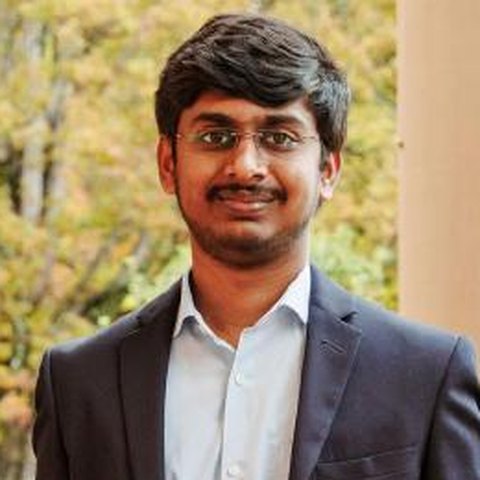
Athish Venkatachalam was a graduate research assistant in the HAIE Lab who built the multi-user, browser-accessible sandboxed Linux desktop environments used to study human oversight of autonomous task execution (IEEE CAI 2025), and led a multi-dimensional evaluation framework for AI-generated workflows (2025). Athish also served in Clemson's Graduate Student Government, including as its president.
Athish earned an M.S. in Computer Science from Clemson University (2025) and a B.Tech. in Computer Science and Business Systems from SRM Institute of Science and Technology, where Athish received the Best Outgoing Student award, and is now a DevOps engineer at SentiLink.
As Generative Artificial Intelligence (AI) and Robotic Process Automation (RPA) tools become increasingly integrated into digital workflows, ensuring the usability of such automation before deployment on live systems is critical. This paper introduces a novel sandbox environment implemented within a virtual machine designed to safely test AI-driven task automation in isolation. The study evaluates user interactions with automated systems through two distinct feedback modalities: direct mouse control and text-based input, across tasks of varying difficulty levels (easy, medium, and hard) through measuring System Usability Scale, task completion rate and NASA TLX. The experiment introduces two primary independent variables: interaction modality and task difficulty. Interaction modality is categorized into direct mouse control by the user versus providing guidance to the AI through a chat interface. Task difficulty is divided into three levels-easy, medium, and hard; each presented sequentially to participants within their assigned interaction modality. A field experiment with 28 participants revealed that direct mouse control outperformed text-based feedback in task completion rates (83.3% vs. 61.9%) and usability. However, as task difficulty increased, user workload also rose significantly, regardless of the feedback modality. Qualitative analysis highlighted common barriers to effective interaction, such as delayed AI responses and frustration with error correction responsiveness. The study aims to identify patterns in user-AI collaboration dynamics, pinpoint challenges in the AI's autonomous decision-making, and assess the efficacy of the intervention methods. The findings are expected to inform the design of future human-centered AI systems that can effectively balance autonomy with user oversight in complex environments.
@inproceedings{Li2025Human,
  title = {Human Oversight Over Autonomous Task Execution in Sandbox Environments},
  url = {http://dx.doi.org/10.1109/CAI64502.2025.00121},
  doi = {10.1109/cai64502.2025.00121},
  booktitle = {2025 IEEE Conference on Artificial Intelligence (CAI)},
  publisher = {IEEE},
  author = {Li, Wangfan and Venkatachalam, Athish and Bowen, Jackson and Toxtli-Hernández, Carlos},
  year = {2025},
  month = May,
  pages = {663--668}
}
In the news
Two papers at IEEE CAI 2025 in Santa Clara: AI for Becoming Fluent and Human Oversight Over Autonomous Task Execution in Sandbox Environments.